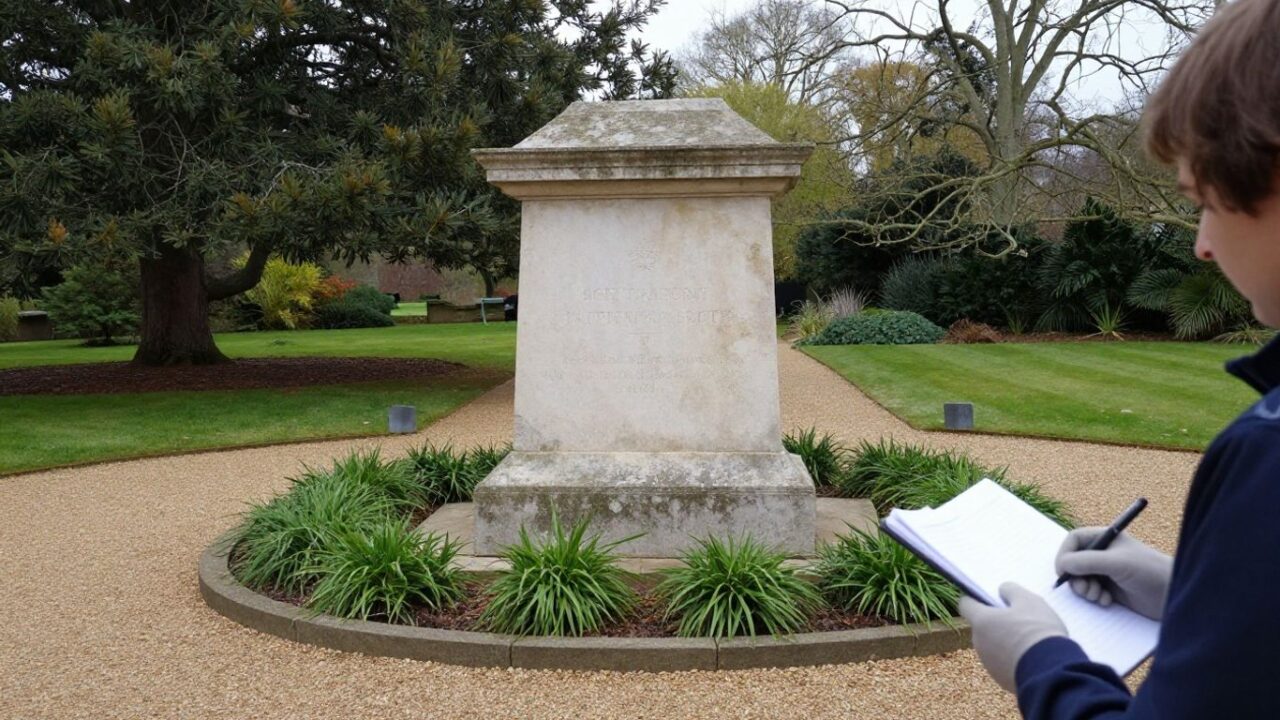
Understand the memorial and its preservation needs
Before we touch a memorial, we need to understand what it is and why it matters. A regimental plaque, a cemetery monument and a museum memorial may share materials but carry different histories and responsibilities. This memorial preservation guide begins with careful observation, research and respect for the people connected to the site.
Identify the memorial’s materials, age, and construction
Start with what we can observe, not what we assume. Record whether the memorial is made from stone, metal, timber, concrete, ceramic or several materials, and note visible finishes, joins, lettering and fixings. Tool marks and small design details can help distinguish original craftsmanship from later repairs.
A concise description gives future caretakers a useful reference. We can record details such as:
- Materials and surface finishes
- Construction and visible fixings
- Lettering, decoration and dimensions
- Any apparent additions or replacement parts
These notes do not need to settle the memorial’s exact age or construction method. They give us a clear starting point and help identify questions for an archivist or conservator.
Research its history, inscriptions, and cultural significance
The object itself may tell only part of the story. We can look for records in museum catalogues, cemetery registers, local histories, regimental archives and family papers, then compare those sources with what is visible on site. When transcribing an inscription, preserve its line breaks, spelling and punctuation rather than silently correcting them.
We should also consider how the memorial has been used and understood over time. A feature that looks minor to a visitor may matter to a regiment, a family or a local community. That context helps us make choices that protect more than the physical structure.
Recognize common causes of deterioration
Weather, water and movement can gradually wear a memorial down. Rain may collect in joints or around a base; freeze-thaw cycles can widen existing cracks; salts can leave deposits or damage porous surfaces. Plants, roots, insects and pollution may contribute too, depending on the setting and materials.
People and routine site work also affect condition. Repeated contact, nearby digging, lawn equipment and poorly directed runoff can cause damage that is easy to overlook. We should record what we see without treating every stain or surface change as proof of a specific cause.
Set preservation goals that respect the memorial’s meaning
Once we understand the object and its setting, we can decide what care should achieve. The aim might be to keep it stable, maintain safe access, protect an inscription or preserve evidence of age. A fresh-looking surface is not always the best outcome; unnecessary intervention can remove meaningful traces of use and time.
A sound plan puts historical meaning first and makes the level of intervention clear. We can agree what must be retained, what risks need attention and what changes are acceptable before anyone starts work. That shared understanding can prevent well-intended cleaning or repair from altering the memorial’s character.
Assess and document the memorial’s condition
A useful condition record gives us a point of comparison, not just a collection of photographs. We should describe the memorial and the area around it in a consistent way, then note when and by whom the record was made. This creates a practical basis for spotting change and deciding when to ask for expert help.
Record the site’s location and surroundings
Record the memorial’s address or mapped location, its orientation and the features around it. Note nearby trees, paths, slopes, drains, walls and sources of water, as these can help explain recurring dampness, wear or access problems. Include any visible changes in the surrounding landscape that may affect the monument.
A site record should be usable by someone who has not visited before. Clear location details and a brief description of access points can help caretakers return to the same place and assess conditions consistently.
Photograph the memorial from consistent angles
Photographs are most useful when we can compare them over time. Take overall views and closer images of inscriptions, joints, the base and areas of concern. Whenever possible, use the same vantage points and similar lighting, and include a reference for scale without touching fragile surfaces.
Keep original image files and note the date and direction of each view. A short caption can explain what the photograph shows, while avoiding conclusions that the image alone cannot support. With consistent records, a small change is less likely to be mistaken for a new problem—or missed altogether.
Note cracks, leaning, biological growth, and missing parts
Describe visible conditions in plain, specific language. Record where a crack begins and ends, whether a section appears displaced, and where moss, lichen or other growth is present. Note missing pieces, loose fittings, flaking finishes or areas where lettering has become difficult to read.
It helps to separate observation from interpretation. Instead of writing that a monument is “failing,” we can describe a visible lean or an open joint and add a photograph. This gives a conservator or caretaker better information without presenting an uncertain diagnosis as fact.
Distinguish routine changes from urgent safety concerns
Some changes develop slowly; others may indicate an immediate risk to visitors or the memorial itself. A new lean, a loose overhead element or a recently opened crack deserves prompt attention, particularly if people can approach the area. We should not test stability by pushing, climbing or handling a potentially loose component.
When deciding what to report first, a simple distinction can help:
- Gradual surface weathering with no apparent movement
- A change that is new or visibly increasing
- A loose, unstable or fallen component
This is a recording aid, not a substitute for a professional assessment. If there may be a safety hazard, keep people away where practicable and contact the site owner or caretaker promptly.
Clean memorials safely
Cleaning can make an inscription easier to read, but it can also remove fragile material or alter a surface. Before we begin, we should know what the memorial is made from and whether a specialist has previously treated it. The safest choice may be to leave a surface untouched until its condition is understood.
Choose methods suited to the stone or other material
Materials respond differently to water, brushes and cleaning agents. A method suitable for a sound, non-porous surface may harm soft stone, flaking paint, corroded metal or delicate lettering. We should first identify the material and consider whether the surface is already weakened.
If cleaning is appropriate, choose the least aggressive method that can address the actual need. Avoid assuming that a darkened area is dirt; it may be a natural surface, a historic finish or a sign of a condition that cleaning will not resolve.
Test gentle cleaning methods in an inconspicuous area
When the material and condition allow cleaning, a small test area can reveal whether the surface reacts badly. Work carefully in a discreet spot and stop if the material changes, flakes, powders or becomes discoloured. A test should not be treated as proof that the same method is safe across every part of a memorial.
Record what was tried and what happened, including the tool or product used. If there is uncertainty about the result, or if the surface is fragile, it is better to pause than to continue across a larger area.
Avoid pressure washing, harsh chemicals, and abrasive tools
High-pressure water can force moisture into joints and dislodge weakened material. Strong chemicals may stain or damage stone, metal, finishes and nearby plant life, while abrasive pads and wire brushes can scratch surfaces and wear away detail. Scrubbing harder is not a reliable way to make a memorial safer or more legible.
A restrained approach protects the parts that cannot be replaced. We should also avoid applying sealants or coatings without understanding the material and the consequences; a treatment that traps moisture can create new problems.
Know when cleaning could cause further damage
Visible growth or staining does not always need to be removed. It may be attached to an unstable surface, or cleaning may erase an old finish or soften already-worn lettering. If flakes, powder, loose fragments or deep cracks are present, cleaning could make the condition worse.
When we cannot tell what a surface can safely withstand, pausing is part of good care.
That pause gives us time to document the condition and seek advice from a qualified conservator. The purpose is not to leave every memorial untouched, but to avoid irreversible work based on guesswork.
Prevent damage through ongoing care
Regular, modest attention can help us notice risks before they become larger problems. Care should suit the memorial’s materials and setting, rather than follow a generic routine. The aim is to reduce avoidable stress while preserving the character of the place.
Manage water, drainage, vegetation, and nearby trees
Look for water collecting at the base, blocked drains, soil washing away or runoff flowing towards the memorial. Nearby roots can disturb foundations, while branches may drop debris or rub against surfaces. We should observe these relationships and discuss changes with the site caretaker before altering drainage or removing vegetation.
Routine garden work can also affect the monument. Keep plants from obscuring inscriptions and avoid allowing climbing growth to attach to fragile surfaces. Where roots or water appear to be causing movement, the issue may need assessment beyond ordinary grounds maintenance.
Reduce risks from foot traffic, weather, and maintenance equipment
Repeated contact can polish, scratch or weaken accessible surfaces, and foot traffic may compact soil around a base. Mowers, trimmers and vehicles can chip edges or strike fittings. Weather exposure is harder to control, but we can sometimes reduce additional risks by maintaining sensible access routes and keeping equipment at a safe distance.
Any protective measures should respect how the memorial is used. A barrier that prevents accidental contact may also obstruct ceremonies or access, so we should consider the setting and consult the people responsible for the site before making changes.
Schedule regular inspections and seasonal upkeep
A predictable inspection routine makes changes easier to notice. We can check the memorial after seasonal shifts, heavy rain, strong winds or nearby maintenance work, and arrange more frequent visits if earlier records show recurring problems. Inspections need not be elaborate; consistency matters more than a long list of tasks.
Use each visit to look at the same features: the base, joints, inscriptions, nearby drainage and any previously recorded areas of concern. If conditions are unchanged, record that too. A clear record of stability is useful evidence for future planning.
Keep a record of maintenance and changing conditions
A shared log helps caretakers understand what has been done and what remains to be watched. Record dates, observations, cleaning or grounds work, weather events and any advice received. Attach dated photographs when they clarify a change, and keep the files somewhere the people responsible can access.
The value of the record is in its continuity. If a new caretaker takes over, they can see which concerns are longstanding and which are recent, rather than starting again with no context.
Plan repairs and restoration responsibly
Repair decisions should respond to the memorial’s condition and significance, not to a preference for a newer appearance. Some work is intended to prevent movement or loss; other work changes how the surface looks. Separating these aims helps us choose a proportionate response and explain why it is needed.
Separate stabilization from cosmetic restoration
Stabilization addresses a risk to the structure or its components. Cosmetic restoration focuses more on appearance, such as making a surface look uniform or refreshing a finish. The two can overlap, but they are not interchangeable, and a visual improvement does not necessarily solve a structural concern.
We should first establish what is at risk and what evidence supports the proposed work. A clear scope can distinguish urgent protective measures from optional changes, helping everyone involved understand what the intervention is meant to achieve.
Consult qualified conservators for structural or delicate work
Structural movement, fragile surfaces, complex materials and deteriorating inscriptions call for specialist assessment. A conservator can examine the condition, consider appropriate methods and explain likely effects before work begins. We should share photographs and condition records, while recognising that an on-site assessment may be needed.
This is especially important when a memorial has unusual construction or several materials joined together. A repair that suits one component may harm another, so experience with comparable conservation work matters.
Preserve original materials and inscriptions where possible
Original material carries evidence of craft, age and use. Replacing it or recutting worn lettering may remove information that cannot be recovered. Where intervention is necessary, we should ask whether the work can retain original fabric and avoid making new additions look like historic features.
Inscriptions deserve particular care. We can document them thoroughly before treatment and seek specialist guidance if letters are flaking or difficult to read. The goal is to retain what remains, rather than make uncertain text appear more complete than the evidence allows.
Check permits, ownership, and heritage requirements before work begins
Before arranging work, confirm who owns or manages the memorial and who has authority to approve changes. There may also be site rules, heritage controls or permit requirements to check. Because responsibilities vary by place and circumstance, we should ask the relevant owner or authority rather than assume that routine maintenance approval covers restoration.
Keep written records of approvals, the agreed scope and any specialist recommendations. Clear documentation helps the work stay within its intended limits and gives future caretakers an account of what changed.
Organize long-term stewardship
A memorial is more likely to receive consistent care when responsibility is shared and practical. Long-term stewardship turns observations and repair decisions into a plan that people can actually maintain. It also protects the history gathered along the way, especially when volunteers or staff change.
Set a realistic preservation budget and maintenance schedule
List routine tasks separately from specialist assessments and larger repairs. Then set a schedule that reflects the memorial’s condition, exposure and available caretaking capacity. A plan that is too demanding may be abandoned, so it is better to agree on achievable actions and review them as circumstances change.
We can note which work requires outside expertise and which observations caretakers can make safely. This distinction helps prevent ordinary upkeep from drifting into unplanned intervention.
Coordinate with owners, caretakers, and community groups
The people connected to a memorial may include landowners, museum staff, veterans’ groups, descendants, local historians and nearby residents. Their knowledge and responsibilities may differ, so early conversation can reveal important context and avoid conflicting plans. We should make space for people with a direct connection to the memorial to explain what matters to them.
Coordination also helps with practical arrangements such as access, inspection dates and communication about proposed work. A shared understanding is especially useful when the memorial has both a public role and a particular community meaning.
Share documentation and define responsibilities
Agree where condition reports, photographs, research and maintenance notes will be kept. Identify who can update them, who should receive reports of new damage and who will contact specialists when needed. Responsibilities should be clear enough that a task does not disappear between organisations or caretakers.
A short written plan is often more useful than an elaborate document that nobody consults. Include the memorial’s basic history, known concerns, routine checks and the people responsible for follow-up.
Review the plan after severe weather or new damage
A preservation plan should change when conditions do. After severe weather, vandalism or nearby construction, we can compare the site with earlier photographs and records, then note any new concerns. If damage appears, record it before attempting a repair or cleanup.
Reviewing the plan also gives us a chance to reconsider responsibilities and inspection frequency. The record should remain open to new evidence, while established conservation decisions are changed only with a clear reason.
Conclusion
Caring for a historic memorial begins with understanding its materials, history and place in the community. When we document change, use restraint and seek qualified help for delicate or structural work, we give future caretakers a stronger foundation for decisions. Thoughtful stewardship is not about making every monument look new; it is about protecting what makes each one worth remembering.